

On this page
- This is no longer a software story
- Cash flow was cute. Then the bill arrived.
- The market has two incompatible bedtime stories
- The productivity math has fine print
- Competition makes everybody act irrationally, perfectly rationally
- No, an AI lab is not Lehman Brothers. Yet.
- The next AI test is boring revenue
The AI boom has graduated from “four rich companies buying GPUs with cash” to a $1 trillion infrastructure race involving lenders, private-credit funds, utilities, contractors and anyone unlucky enough to own a substation near a data centre.
The Bank for International Settlements’ January Bulletin is not predicting a crash. It is pointing at something more interesting, and more dangerous than the usual “is ChatGPT overhyped?” debate: the money financing AI is changing before the revenue case has finished proving itself.
The technology may be real. The productivity gains may be real. The financing can still be spectacularly stupid. Railways did not vanish after railway mania. Neither did the internet after dot-com. A lot of investors simply discovered that civilisation-changing infrastructure is not a substitute for customers paying the bill.
This is no longer a software story
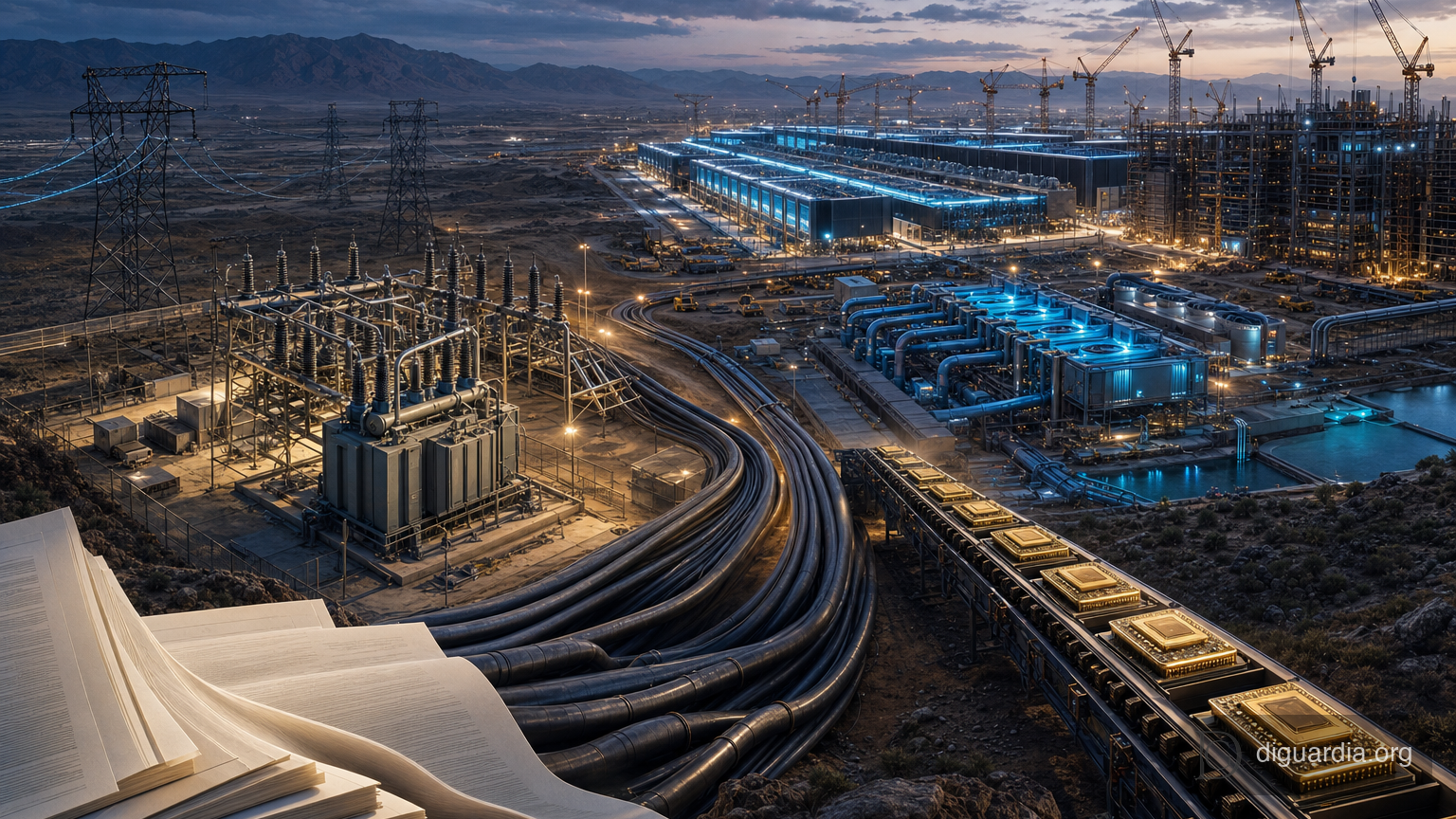
AI gets discussed like software because people interact with a chat box. The bill is mostly hardware, concrete, cooling, transformers, grid connections and extremely expensive chips humming in sheds the size of small airports.
The BIS estimates that, by mid-2025, US spending on IT manufacturing facilities and data centres had reached about 1% of GDP. Total IT investment reached 5% of GDP, above its dot-com peak. Semiconductor-factory and data-centre investment has added an average 0.4 percentage points to US GDP growth since 2022.
That is a serious economic contribution. It is also gross investment, not a magic stamp saying every dollar will earn an attractive return. The Bulletin itself notes that some equipment is imported, so the headline growth contribution can overstate the domestic net effect.
The BIS Annual Economic Report 2026 puts an even larger number on the near-term race: the five largest hyperscalers are set to spend over $1 trillion on AI-related capital expenditure across 2025 and 2026.

Cash flow was cute. Then the bill arrived.
For years, the biggest AI spenders had a wonderfully boring advantage: they could fund huge bets out of operating cash flow. That is what happens when your existing businesses print money at planetary scale.
The next phase is less clean. The BIS says anticipated investment needs will push firms from operating cash flows towards debt financing, with private credit taking a growing role. Its Bulletin estimates that data-centre spending could rise by $100 billion to $225 billion annually over five years, from roughly 0.5% of US GDP today to 0.8%-1.3%.
Private credit is not a cute side alley any more. The market grew from around $100 billion in 2010 to more than $2.2 trillion. BIS researchers find AI-linked loans have expanded sharply, and their average size is larger than loans to non-AI firms.
This does not mean “private credit bad” or “data centre = Lehman Brothers.” It means the blast radius changes. A disappointing AI revenue cycle would no longer mostly punish venture capital and public shareholders. It could run through specialist lenders, infrastructure owners, construction firms, equipment suppliers, power contracts and retirement portfolios that own some piece of the chain.
The market has two incompatible bedtime stories
Here is the BIS’s sharpest observation. Equity markets are pricing AI firms for extraordinary future earnings. Debt markets, meanwhile, are not obviously charging them extraordinary credit risk.
In human language: shareholders are betting on a gold rush. Lenders are pricing something closer to a normal construction project. Both views can be right for a while. They cannot both be right forever if the cash flows disappoint.
The Bulletin finds that AI loans have broadly similar spreads and maturities to other private-credit loans. Spreads are the extra interest lenders demand to take risk. If the entire future of the investment rests on huge revenue growth that has not materialised yet, “roughly normal” credit pricing is not proof of safety. It is a question mark wearing a tie.
That matters because the AI price war already splitting the stock market makes the revenue side harder, not easier. If capable models keep becoming cheaper and more interchangeable, spending fortunes on proprietary capacity becomes a much tougher bet to recover through pricing power.
The productivity math has fine print
None of this requires believing AI is useless. That lazy conclusion is the mirror image of pretending every GPU purchase is a productivity miracle.
The Annual Economic Report notes studies showing 20%-50% time savings on particular tasks. That is not nothing. But long-horizon estimates for aggregate productivity growth are generally below 1%, because turning a clever tool into economy-wide output means changing processes, cleaning data, rebuilding approvals, retraining people and accepting that every company has at least one spreadsheet maintained by a person called Keith.
Task-level usefulness and economy-level payoff are not the same thing. A company can save ten minutes per employee per day and still fail to justify a multibillion-dollar power-and-compute commitment. The return must arrive at the right scale, at the right speed, and in enough firms to cover the concrete already being poured.
Competition makes everybody act irrationally, perfectly rationally
The BIS’s annual report describes an investment contest driven by the belief that a small number of winners will dominate. That creates an ugly but understandable incentive: spend aggressively now, because being the lab that stopped buying compute before the next breakthrough is a career-limiting decision.
Individually rational moves can produce collective overbuilding. The report’s contest model finds that as competition pushes capex higher, total sector surplus falls and can turn negative in an adverse scenario. That is not a forecast. It is a formal way of saying that five people sprinting to buy the same scarce shovel can all overpay for shovels.
Supply bottlenecks make it worse. Electricity, advanced semiconductors and grid equipment are scarce. Firms lock in long-dated capacity contracts to avoid being stranded later. Sensible under scarcity, painful if demand or utilisation fails to match the heroic spreadsheet.
There is another complication: circular AI financing. The annual report describes reciprocal structures where chip makers or hyperscalers take equity stakes in AI labs, while those labs commit to buy chips or compute. This is not automatically fake revenue, and calling it that would be finance-bro fan fiction. It does create correlation. If one leg falters, several “independent” revenue and financing assumptions can wobble together.
That is especially awkward when Chinese and open-weight AI competition keeps undermining the idea that only the most lavishly funded closed model can matter. The cheaper capability gets, the more brutal the return-on-infrastructure question becomes.
No, an AI lab is not Lehman Brothers. Yet.
The best response to this story came from the Hacker News discussion, which immediately tried to turn it into “too big to fail.” That comparison is premature.
Banks were rescued because they sat inside the payment and credit plumbing of the economy. A frontier-model lab with a huge valuation is not automatically a systemically essential institution. A government guarantee cannot rescue a structurally unprofitable operating model any more than it can make a deserted shopping mall emotionally available.
The more plausible risk is duller: a correlated investment unwind. Lenders discover that utilisation assumptions were optimistic. Contractors find long-term commitments delayed. Utilities and data-centre operators inherit awkward capacity. Public markets reprice the firms that were supposed to turn all that capex into cash.
The HN thread also makes a fair methodological complaint. The Bulletin presents medium- and high-growth demand paths for data centres, not a fully ugly demand-collapse scenario. That does not invalidate the warning. It tells us exactly what the next serious analysis needs to stress-test.
The next AI test is boring revenue
The BIS conclusion is more restrained than the panic merchants would like. It says macroeconomic and financial-stability risks appear moderate today, while the boom’s sustainability depends on firms meeting high earnings expectations. That is the correct framing.
AI does not need to become worthless for this to hurt. The test over the next two years is not another benchmark chart or a founder announcing that agents are about to replace the procurement department. It is utilisation, enterprise renewals, pricing power, power contracts, debt maturities and cash flow.
Those are boring words. They are also the words that decide whether the AI build-out becomes productive infrastructure, or a very expensive monument to the period when every boardroom confused “we cannot afford to lose” with “this will make money.”
Keep reading